Challenges caused by COVID-19 on Food and Agriculture:
1)Food supply problem:
National responses to mitigate the COVID-19 pandemic are threatening the integrity of vital global supply chains. The United Nations Global Compact is calling for a comprehensive, systemic and coordinated global approach. A global 'key worker' status recognizing essential ocean-based services would give these workers a right to transit and medical attention. Almost 90% of global trade is transported by sea. At the same time, the offshore industry is a major component of global energy supply, while mariculture and capture fisheries constitute vitally important sources of food and animal feeds. Our ocean’s wide-ranging supply chains are responsible for the continued flow of food, fuel, medical supplies, raw materials, and agricultural products. These underpin national economies, job security, and the health and wellbeing of all people. While epidemiological data and risk assessments show that COVID-19 measures continue to be necessary, closed borders, curtailed travel, quarantines, and other restrictions are impeding the movement of the goods and workers needed to keep these critical global supply chains moving. Shipping lies at the very core of the global logistical system. At any given time, 50,000 vessels and 1.2 million seafarers are in operation. National COVID-19 measures, local restrictions, and reduced manpower capacity in ports are making it increasingly challenging for ships to dock, load, and disembark. Travel restrictions and grounded airplanes are making the monthly changeover of 100,000 crew members on ships virtually impossible. Changeovers due in April have generally been postponed for a month. Although work cycles vary in the offshore sector, capture fisheries and coastal fish farming, similar problems lie around the corner.
2)Losing jobs and pending paycheques
Due to the sudden breakdown of the economy, several firms couldn’t pay some of their employees and as a result, the companies had to fire those employees or had to hold their paycheques. Over 30 Million people lost their jobs in the US alone. Daily wage laborers couldn’t get work to get paid for the day. So due to this reason, families across nations lost the source of bread and butter. This problem is seen not only in struggling nations but also in well-developed nations like the USA. Some nations brought certain relief funds to help families but some of those nations were unable to consider daily wage laborers.
Most of the people depend on groceries they buy to fill their tummies but when their pockets are empty, that becomes a problem. Many people didn’t have enough stock to last for some days. Many people don’t have savings for this kind of situation. So preventing these people from starving remained a challenge throughout oceans. Most of the underdeveloped nations seem to have failed in this regard.
3)Migration of laborers
Governments around the world have taken action to protect people’s lives and livelihoods in response. But thus far the unique challenges of migrants and their families have been addressed in too few cases. Ensuring that migrants are included in policy responses can help protect this particularly vulnerable group during the crisis. But protecting migrants means reducing the risk of transmission for the entire population while helping sustain a source of labor that will be critical to recovery from the economic effects of COVID-19. Now moving on to the effect on the agriculture and food sector, it is not a new thing that migration definitely decreases agricultural production and in the current scenario it is being more clear and the consequence is having a very bad effect on the food and agriculture industry. In the time when food production should be at its absolute peak, instead, it is on a decline.
4)Closure of Industries and business
Due to COVID-19 many of the food and agriculture sectors are being hit hard. Due to the restriction from their respective governments they are not able to carry their business, mainly in our country Nepal, the vast majority of industries are closed. Extended till 14th June, the lockdown is having an effect on all sorts of businesses across the country. Food availability in markets was considered to be insufficient by 53% of traders. Those businesses which have started to operate also are functioning only at about 8-50% of their capacity a day. Also, due to the lockdown distribution of sales is largely affected. High impact of this is seen on items which are considered non -essentials like bakery items, dry fruits, meats, eggs, etc. This impact on non -essential items has caused huge distress for the farmer who depends on this kind of item for livelihood and also the concerned business is too being affected. This is nonetheless case with the whole world with some countries having it worse than us while some having it a little better.
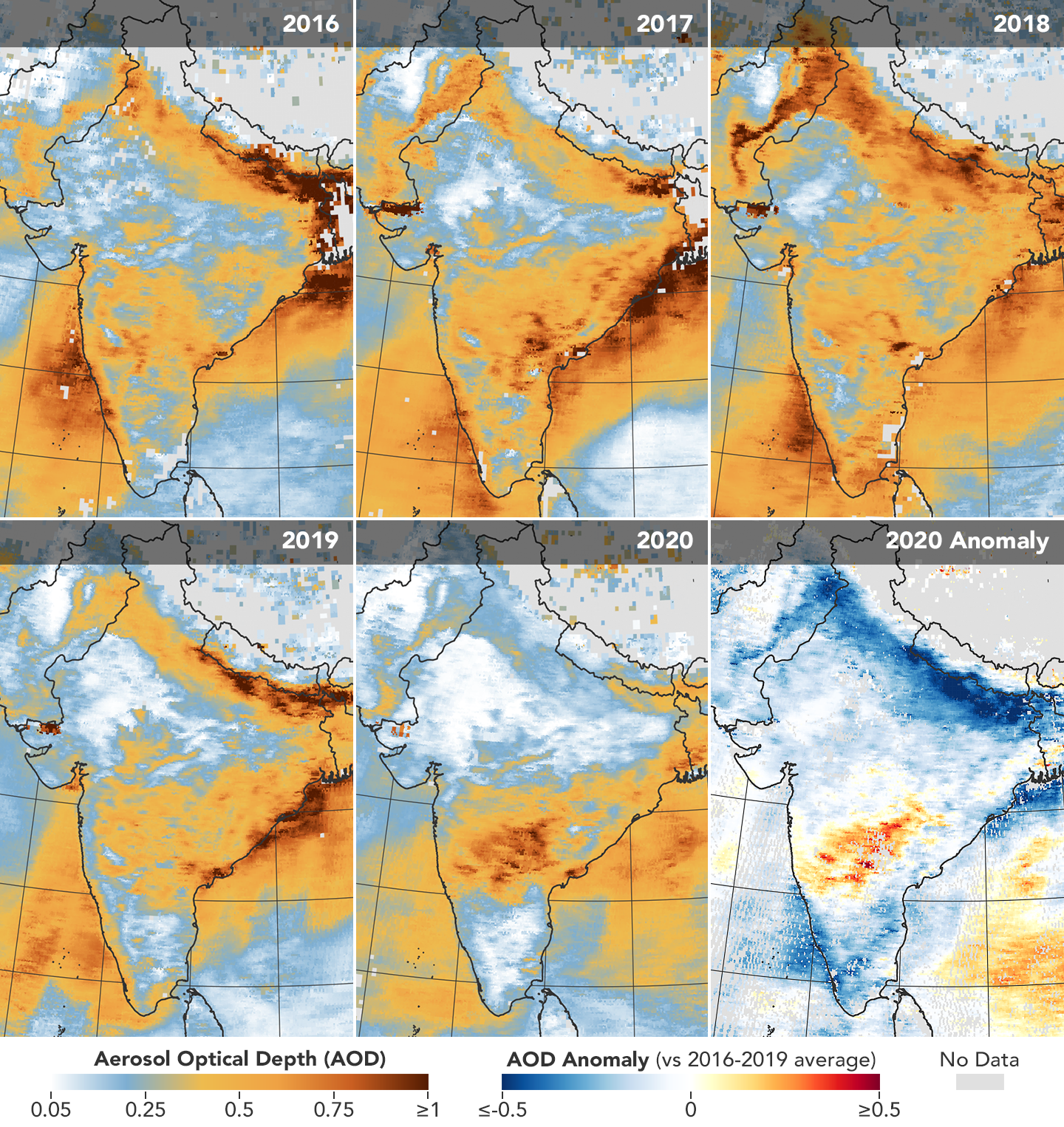
NASA satellite sensors observed aerosol levels at a 20-year low for this time of year in northern India. In this image which was captured by NASA, we can easily see the effect of the shutdown on all types of businesses which resulted in the decrease of usage of transportation drastically and hence the decrease in aerosol level.
5)Hoarding Of Food :
Panic buying ( alternatively hoarding of food) occurs when consumers buy usually large amounts of products in anticipation of a perceived disaster. With news of the COVID-19 pandemic, thousand of consumers across the world panic brought food and other essentials. The rapidly growing Coronavirus pandemic is so far having little impact on the global food chain but that could change for the worse – and if anxiety-driven panic by major food importers take hold, the World Food Programme (WFP) has said. Large no. Of people stockpile food due to which another half of the population receives very few amount of food to eat that would last for 15-20 days. Panic buying along with the lack of delivery of food items makes the situation more worse. It is a phenomenon that drives the prices of the goods and creates a shortage of the vital. You should understand the fact that the nation has enough food to supply to its citizens for about 6 months. So, people should stop hoarding of food else there will be an unbalanced situation where someone might be having surplus food for the whole year and others might be forced to suicide due to hunger.
6)Unavailability of farming essential
The coronavirus has had a very dramatic impact on the agricultural sector in Nepal. With the lockdown imposed most of the farmers have failed to bring essential goods to the field as there has been the prohibition of transportation in the country. The farmers now are suffering because of this rule thus it can be estimated if necessary steps are not taken in time then even though the weather allows the farmers for better production, they would still lack the production needed due to the unavailability of adequate fertilizers during this lockdown.
7)Malnutrition:
Malnutrition had been one of the major problems since the beginning especially for poor countries like Nepal. The previous year data showed Nepal barely had improved from the previous years status however with the lockdown implemented and most of the families still not receiving their wages have failed to provide nutrition to the children and thus this problem could, in fact, be one of the major problems for the post COVID period.
The number of people facing acute food insecurity (IPC/CH 3 or worse) stands to rise to 265 million in 2020, up by 130 million from the 135 million in 2019, as a result of the economic impact of COVID-19, according to a WFP projection. The estimate was announced alongside the release of the Global Report on Food Crises, produced by WFP and 15 other humanitarian and development partners.
Our solutions to it:
Insurance Of Farmers :
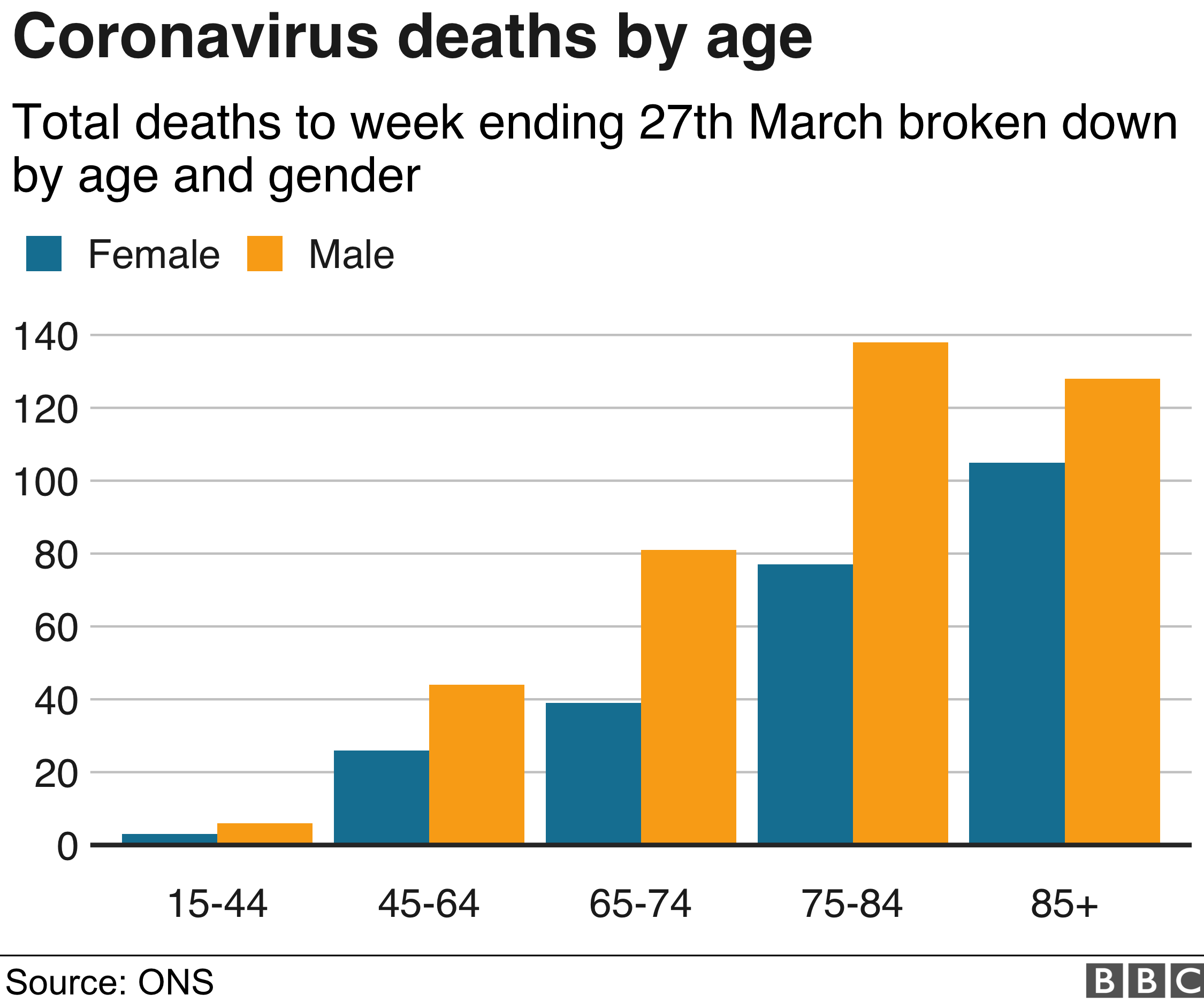
As the cases of Coronavirus increases, fear among the farmers, production labors and delivery seem to be rising. We see most of the people working on the farm are mostly above 50-60 years old and they are more susceptible to the disease.
The following graph shows how people above 50 years of age are riskier to Coronavirus. In this regard, farmers wouldn’t want to work on farms with no or less preventive measures risking their life. If they ever stop working, there is certainly going to be a good crisis in the country. So, one way we can have our farmers work safely is by ensuring them insurance. These insurances will hold two parts: Life insurance and Non- life insurance. Life Insurance includes the health of farmers where the government will be bearing all the testing fees, quarantine fees, etc. Similarly, Nonlife insurance includes insurance for a certain amount of land that would produce food/crops of some cash value. And the government should bear all this insurance. This is one of the ways we can solve the food crisis in our country.
Strengthening the Supply Chain Mechanism and production:
Countries must implement the following core measures. First, they should bring collection centers closer to smallholder producers to reduce the need for mobility. Collection centers should have high capacity. Food banks can play a significant role given their knowledge, as well as horizontal and vertical coordination mechanisms with farmers’ associations engaged in contract farming arrangements. Second, countries, when feasible, should establish warehouse receipt systems to farmers to use the receipts to get their payments. Third, countries should accelerate the development of e-commerce for smallholders. Fourth, smallholder farmers must have access to finance, so that they can continue to produce. A number of countries are introducing stimulus packages that lack clear incentives for smallholder farmers. Farmers need cash handouts and safety net programs that can enhance their productivity. Banks should wave fees on farmers’ loans and extend payment deadlines. A capital injection in the agricultural sector can help small and medium agri-businesses to continue operations. Improving storage can help reduce post-harvest crop losses along the supply chain. Any constraints to domestic trade, including bureaucratic hurdles, should be removed in order to link smallholder farmers to markets. Governments should meet the basic energy needs of smallholder farmers and rural households. For many children in rural areas, too, school closures mean that they don’t have access to a healthy diet. For producers, it translates into a loss of income. Local governments must consider an alternative to school meals, such as home delivery of meals to keep the producers employed and children nourished. During an emergency, governments can purchase agricultural products from smallholder farmers to establish strategic emergency reserves, especially for non-perishable commodities to boost food supply. This can be used to deliver safety net programs and school meals even when schools are closed. Countries should put measures in place to assure the safety of farmworkers. On-site healthcare professionals can ensure workers are not ill. If possible, workers should be tested for the coronavirus. At-home coronavirus tests, when they become available, could make this easier. Governments should expedite migrant workers’ visas to prevent labor crunches on-farm and plants, even if it seems counterintuitive. Growers and warehouses should eliminate visitors. Shops should reduce their hours, rotate the staff and double down on their delivery services. Warehouses and processing plants should be re-engineered to enable workers to practice social distancing. Health professionals should take temperatures of employees and make sure they are wearing masks, gloves and other protective gears
Food Banks
To save people from starvation, Foodbank is an effective solution. What we could do is, collecting a small amount of food, for example, a small bowl of rice from households that are willing to contribute, daily. In this way, we can collect different food items and distribute it to the people who are in need. We could also raise funds or small donations of raw materials for cooking from different entities of the society and use the restaurants that are closed during shut down to cook food for the needy. These practices have been seen in some parts of India where millions of migrant workers were moving from cities to their hometowns on foot, starving throughout the journey.
We could also use innovation to solve this problem. We could approach companies which provide ride-sharing services like Uber and Lyft to use their innovation to track the location of people who are willing to contribute to get to them and collect the help that they would like to provide. And we could use that mechanism to find who is in need and help them accordingly.
Use Of Local Resources :
The problem of food production and supply can be easily mitigated by making Nepal a “ self-agrarian society “. Among Terai, Himalayan, and hill region, the Terai region is best for the production of food due to geographical conditions, fertile land, easy irrigation, and good climatic conditions. Although the Terai region consists of only 23% of the total land area, it produces 68% food of the total food produced in Nepal. During this pandemic, more than 2 lakh migrant workers and students will arrive in Nepal by June 1st from foreign countries. It will be a wise idea to deploy those people in the agricultural field which will increase the amount of food production to a great extent. And those people won't have to sit unemployed in the country. And Nepal can produce surplus food itself. Apart from cultivation, attention should also be given to handling, processing, and preservation aspects of agricultural products. Studies show that about 40% of the total production of agricultural commodities is unfortunately wasted due to the inadequate facilities for processing and post-harvest technology. In this case, private companies should invest in making food and agro-processing enterprises. These are the only feasible enterprises in the context of Nepal because they improve food nutrition. So, in a nutshell, we have enough potential to grow agricultural products for the whole population. The question arises in processing and delivery. So if the government and private sector would contribute and invest in these fields, Nepal will surely have the surplus food supply
Other solutions which can be beneficial:
>Agriculture inputs like pesticides, fertilizer be made available at the concerned rate
>Various seminars and training on modern agriculture and food processing be held at local and national level
>Means of transport for food delivery from small farmers and producers to local market be regulated
>E-commerce based apps are encouraged to deliver goods to households to minimize mass public interaction
As we can see from data results from JAXA that suggests that right now is the best time for cultivation in Nepal so if not this time around then it might be hard for Nepal to face the COVID-19 effects.
For our project demonstration through video:
With the help of data and news of development of problems across continents related to food that was brought forth from different media sources.The stories of millions of people who are suffering starvation and going through the worst times of their lifetime. We have not used any coding or machine learning rather simple solutions which we all worked on as a group.
NASA Earth Data Resource Examples for Agriculture - Food and Agriculture Organization of the United Nations
NASA Earth Data Resource Examples for Agriculture - World Food Programme
22509-Article Text-70547-1-10-20190129.pdf
http://www.reanda-international.com/News_Photo/pdf/P_i_C_N_E.pdf
WFP-0000115490.pdf